
Whole Body Cryotherapy Better than Ice Baths for Muscle Growth?
Whole Body Cryotherapy Better than Ice Baths for Muscle Growth Summary
- Whole Body Cryotherapy does not adversely affect muscle strength or aerobic performance. However, it may impact jumping power, potentially affecting explosive power development.
- Whole Body Cryotherapy is not particularly effective in reducing body fat or does not reduce muscle growth.
- Whole Body Cryotherapy offers a viable recovery option for those focusing on strength gains without compromising muscle growth.
Introduction to Whole Body Cryotherapy
Ice baths have become increasingly popular among athletes and celebrities’ athletes for their recovery, anti-inflammatory, and immune-boosting properties. However, ice baths have a downside – the potential to hinder muscle growth and testosterone levels, which could negatively impact long-term training adaptations. I have written about this in other articles on Evidence Based Muscle. This is where whole body cryotherapy (WBC) becomes a modern alternative.
Unlike ice baths, WBC involves brief exposure to extremely low temperatures and has gained popularity among athletes and celebrities. A study that caught my eye in 2022 titled “The Effect of Repetitive Whole Body Cryotherapy Treatment on Adaptations to a Strength and Endurance Training Programme in Physically Active Males published in the journal Frontiers in Sports and Active Living‘, explored the impact of repetitive whole-body cryotherapy on adaptations to strength and endurance training in physically active males. (Haq et al., 2022)
The extreme cold of WBC stimulates vasoconstriction, or the narrowing of blood vessels, followed by vasodilation, the widening of blood vessels, once the body exits the cryotherapy chamber. This alternating constriction and dilation of blood vessels is believed to have several effects on the body, including increased blood circulation, reduced inflammation, and pain relief.
Benefits of Whole Body Cryotherapy (WBC) in Athletic Recovery’
 Like ice baths, WBC is a valuable tool for post-exercise recovery, known for reducing pain, swelling, and inflammation. (Lombardi et al., 2017) WBC involves short exposures to air temperatures below −100°C (Bleakley et al., 2014). Athletes and coaches use it to aid in recovery from exercise-induced muscle damage (EIMD) and potentially improve muscle strength and performance. (Christophe Hausswirth et al., 2011) Moreover, the effects of WBC on muscle soreness and recovery have been a subject of interest
Although reducing inflammations benefits short-term recovery (Haq et al., 2021; C. Hausswirth et al., 2011), there’s debate over its long-term impact on reducing training adaptations. Many studies have found that reducing inflammation can reduce long-term muscle and strength gains. Inflammation post-exercise is essential for muscle repair and regeneration (Fatouros & Jamurtas, 2016), raising questions about WBC’s continual dampening of these responses. This raises the question, does long-term WBC reduce muscle gains and strength like long-term ice baths?
Whole Body Cryotherapy vs. Ice Baths
Both whole body cryotherapy and ice baths are forms of cold therapy used to aid in muscle recovery, but they differ in application and effects on the body.
 Ice baths, also known as cold water therapy, involve immersing the body, or specific body parts, in cold water typically ranging from 50 to 59 degrees Fahrenheit. Ice packs or ice application can also be used to target specific areas of the body. This cold therapy is believed to reduce blood flow to the muscles, constrict blood vessels, and decrease inflammation. Ice baths have been a go-to method for athletes for years due to the accessibility and affordability of cold water.
On the other hand, whole body cryotherapy uses extreme cold temperatures, achieved through the use of liquid nitrogen vapors, to trigger a systemic response in the body. Cryotherapy chambers are designed to expose the entire body to these cold temperatures for a short period, typically 2 to 4 minutes. The rapid drop in skin temperature during cryotherapy is believed to stimulate blood circulation, reduce inflammation, and promote muscle recovery.
Ice baths, a long-standing recovery method, are known for their anti-inflammatory effects but have been shown to potentially blunt muscle growth and suppress testosterone levels (Fyfe et al., 2019; Roberts et al., 2015). While less studied, WBC offers a different approach, with its long-term consequences on training adaptations still under scrutiny. There have been no studies looking at WBC on the anabolic responses, but we do have long-term responses to WBC on body composition (i.e., muscle gains and body fat).
The Study: A Closer Look at Whole Body Cryotherapy on Performance
 The study “The Effect of Repetitive Whole Body Cryotherapy Treatment on Adaptations to a Strength and Endurance Training Programme in Physically Active Males” provides insights into WBC’s impact. Participants underwent a six-week training regime, complemented by two weekly 3-minute sessions of WBC. Each WBC session involved a two-stage process, where participants first entered a vestibule chamber at −60°C for 30 seconds, followed by the main chamber at −120°C for 150 seconds. The training program consisted of two weekly strength and plyometric training sessions and two weekly 30-minute runs.
Results: Whole Body Cryotherapy Does Not Impact Strength Gains but May Affect Power
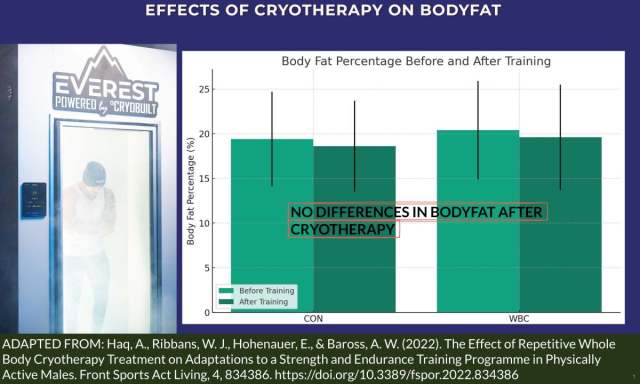
The results showed that WBC did not affect aerobic performance or muscle strength. Interestingly, many people advocate WBC for fat loss. However, the study found no significant difference between the WBC and CON groups over time in terms of body fat changes.
Also, there were no differences in muscle mass between the groups. The peak power results for jumping power, a measure of peak power output, indicated a trend towards a more substantial improvement in jump height in the CON group (i.e., no cryotherapy) compared to the WBC group.

Implications for Muscle Growth and Athletic Performance
The study suggests that WBC may not be effective for body fat reduction, nor does it hinder strength adaptations or muscle growth. However, it might affect peak power adaptations, indicating a potential negative impact on explosive power development.
A possible reason for the differing impacts of whole-body cryotherapy (WBC) and Cold Water Immersion (CWI) lies in their distinct modalities and mechanisms of cold exposure. CWI, unlike WBC, creates a hydrostatic effect and conducts heat more effectively due to its use of cold water (Bleakley et al., 2014; (White & Wells, 2013)).
Consequently, WBC might not impede the supply of amino acids to muscles or the anabolic cell signaling as much as CWI. This theory gains support from research showing that CWI causes more significant reductions in blood flow to the lower limbs than WBC (Mawhinney et al., 2017)Therefore, more research is needed on the repetitive use of WBC in training programs to fully understand its effects and mechanisms, particularly concerning its potential influence on muscle strength and hypertrophy.
Practical Applications for Using Whole Body Cryotherapy
WBC might be a viable recovery option for athletes and fitness enthusiasts, especially for those focusing on strength gains. However, athletes requiring peak power might need to consider the potential drawbacks. The good thing noted about this study was that WBC did not affect muscle gains. The benefits of whole body cryotherapy may be something athletes should consider including in their training program.
Conclusion
Whole Body Cryotherapy presents an alternative to traditional ice baths, particularly in its lack of impact on muscle strength and lean mass changes. As the scientific community continues to explore its effects, athletes and trainers can consider WBC as part of their recovery regimen, considering their specific training goals and the nuances of this therapy.
References
Bleakley, C., Bieuzen, F., Davison, G. W., & Costello, J. (2014). Whole-Body Cryotherapy: Empirical Evidence and Theoretical Perspectives. Open Access Journal of Sports Medicine. https://doi.org/10.2147/oajsm.s41655
Fatouros, I. G., & Jamurtas, A. Z. (2016). Insights into the molecular etiology of exercise-induced inflammation: opportunities for optimizing performance. J Inflamm Res, 9, 175-186. https://doi.org/10.2147/jir.S114635
Fyfe, J. J., Broatch, J. R., Trewin, A. J., Hanson, E. D., Argus, C. K., Garnham, A. P., Halson, S. L., Polman, R. C., Bishop, D. J., & Petersen, A. C. (2019). Cold water immersion attenuates anabolic signaling and skeletal muscle fiber hypertrophy, but not strength gain, following whole-body resistance training. J Appl Physiol (1985), 127(5), 1403-1418. https://doi.org/10.1152/japplphysiol.00127.2019
Haq, A., Ribbans, W., & Baross, A. W. (2021). The Effects of Age and Body Fat Content on Post-Downhill Run Recovery Following Whole Body Cryotherapy. Int J Environ Res Public Health, 18(6). https://doi.org/10.3390/ijerph18062906
Haq, A., Ribbans, W. J., Hohenauer, E., & Baross, A. W. (2022). The Effect of Repetitive Whole Body Cryotherapy Treatment on Adaptations to a Strength and Endurance Training Programme in Physically Active Males. Front Sports Act Living, 4, 834386. https://doi.org/10.3389/fspor.2022.834386
Hausswirth, C., Louis, J., Bieuzen, F., Pournot, H., Fournier, J., Filliard, J. R., & Brisswalter, J. (2011). Effects of whole-body cryotherapy vs. far-infrared vs. passive modalities on recovery from exercise-induced muscle damage in highly-trained runners. PLoS One, 6(12), e27749. https://doi.org/10.1371/journal.pone.0027749
Hausswirth, C., Louis, J., Bieuzen, F., Pournot, H., Fournier, J., Filliard, J. R., & Brisswalter, J. (2011). Effects of Whole-Body Cryotherapy vs. Far-Infrared vs. Passive Modalities on Recovery From Exercise-Induced Muscle Damage in Highly-Trained Runners. PLoS One. https://doi.org/10.1371/journal.pone.0027749
Lombardi, G., Ziemann, E., & Banfi, G. (2017). Whole-Body Cryotherapy in Athletes: From Therapy to Stimulation. An Updated Review of the Literature. Front Physiol, 8, 258. https://doi.org/10.3389/fphys.2017.00258
Mawhinney, C., Low, D. A., Jones, H., Green, D. J., Costello, J. T., & Gregson, W. (2017). Cold Water Mediates Greater Reductions in Limb Blood Flow than Whole Body Cryotherapy. Med Sci Sports Exerc, 49(6), 1252-1260. https://doi.org/10.1249/mss.0000000000001223
Roberts, L. A., Raastad, T., Markworth, J. F., Figueiredo, V. C., Egner, I. M., Shield, A., Cameron-Smith, D., Coombes, J. S., & Peake, J. M. (2015). Post-exercise cold water immersion attenuates acute anabolic signalling and long-term adaptations in muscle to strength training. J Physiol, 593(18), 4285-4301. https://doi.org/10.1113/jp270570
White, G. E., & Wells, G. D. (2013). Cold-water immersion and other forms of cryotherapy: physiological changes potentially affecting recovery from high-intensity exercise. Extrem Physiol Med, 2(1), 26. https://doi.org/10.1186/2046-7648-2-26
The Benefits of Whole Body Cryotherapy
In recent years, Whole Body Cryotherapy (WBC) has gained popularity in wellness centers as a minimally invasive procedure offering numerous health benefits. This treatment involves brief exposure to extremely cold temperatures in an enclosure, often using argon gas. Whole Body Cryotherapy benefits include chronic pain reduction to enhancing overall wellness.
For those suffering from rheumatoid arthritis, fibromyalgia, and sclerosis, WBC treatment can significantly reduce pain. It’s may also be beneficial for professional athletes, including soccer players, helping alleviate muscle pain and sore muscles post-training. There’s anecdotal evidence suggesting improvements in energy expenditure and metabolism, contributing to weight loss. While not a cure for heart disease or high blood pressure, it can complement medical treatment under a healthcare provider’s guidance.
Patients with nerve damage, migraines, or those recovering from a surgical procedure have reported better sleep and improved sleep quality after WBC sessions. The FDA has yet to approve WBC for treating arthritis, fibromyalgia, or sclerosis, so it’s essential to consult with a healthcare provider before considering it. While WBC is generally safe, risks like frostbite warrant careful consideration.
In conclusion, WBC offers a range of health benefits, from managing chronic pain and skin conditions to aiding in recovery for athletes. As a wellness tool, it’s a promising, though not all-encompassing, addition to health and wellness regimens.


